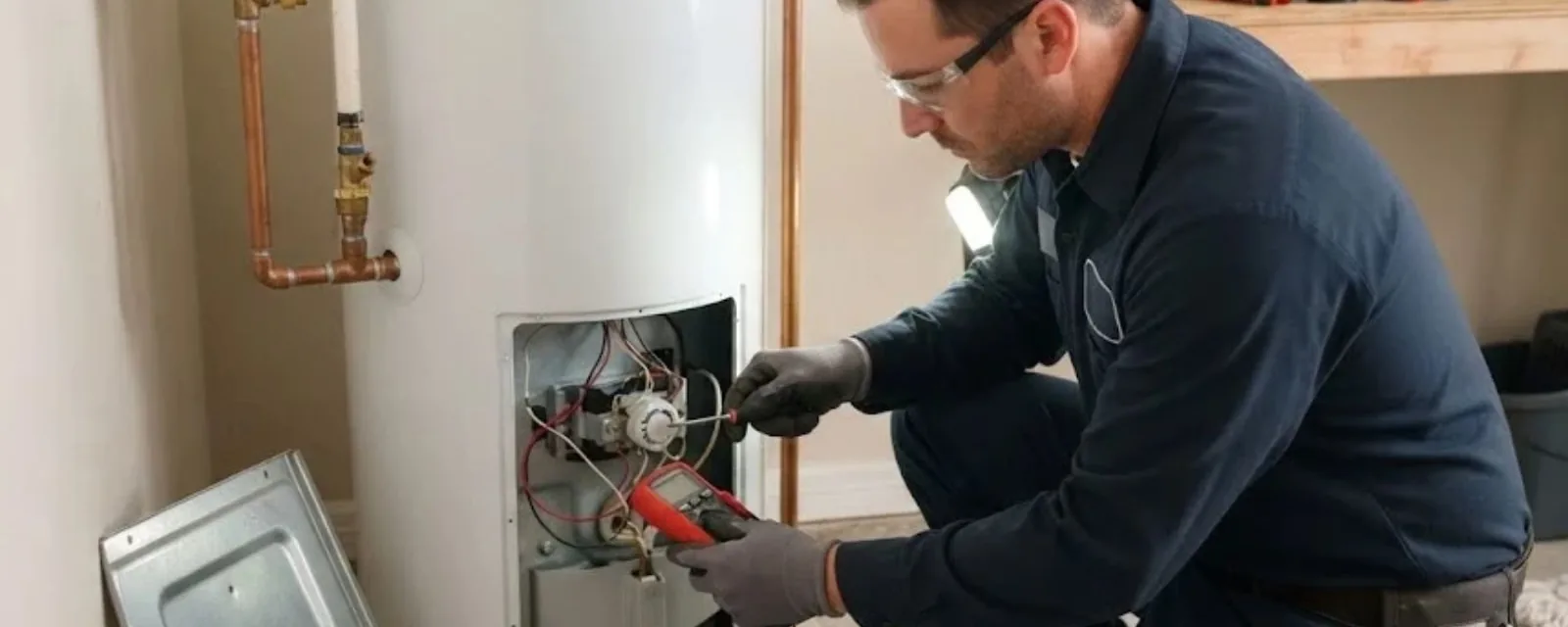
What the relief valve does and why you should care
The temperature and pressure relief valve, often called the TPR valve, sits on the side or top of a tank water heater. It is the last line of defense. If the tank gets too hot or the pressure rises too high, the valve opens and lets water out through the discharge pipe.
Without it, a tank can build up dangerous pressure. A valve that works is a quiet part of the house. A valve that drips, hisses or has been left unchecked for years is telling you something, and ignoring it can end badly.
Signs the valve needs attention
Check these on a day when you have time to look, not when water is already on the floor.
- Water dripping from the discharge pipe, either steadily or in bursts.
- A hissing or rattling sound near the top of the tank.
- Crusty white or green buildup around the valve or the end of the pipe.
- A lever that is stuck, loose or will not snap back when lifted.
- A valve that is old and has never been tested.
A valve that opens once in a while may be doing its job. A valve that drips all the time has either worn out or is answering a pressure problem somewhere else in the system.
Do not cap it and do not plug it
Never put a cap, plug or valve on the end of the relief discharge pipe, however much the drip annoys you. A blocked pipe defeats the safety valve, and the tank can fail with force. If the pipe is dripping, the cure is to find out why and replace or fix the cause.
On a gas heater that smells of gas, leave the building first. Then call the gas utility or 911. Do not look for the leak yourself.
How a plumber replaces the valve
The swap is short, but each step matters because the valve is a safety part.
Cut power or gas.
The plumber turns off the electric breaker or sets the gas control to off, so the tank cannot heat during the work.
Close the cold supply.
The cold water valve above the tank is shut and a hot tap is opened to relieve pressure.
Lower the water level.
Enough water is drained from the tank that it will not pour out when the valve comes off.
Remove the old valve.
The discharge pipe is disconnected and the valve is unscrewed from its fitting on the tank.
Install a matching valve.
A new valve with the same pressure and temperature rating goes on with thread sealant, and the discharge pipe is reconnected.
Refill and test.
The tank is refilled with a hot tap open to push out air, power or gas goes back on, and the lever is lifted to confirm it opens and seals.
The discharge pipe should run downward, end where scalding water cannot hit a person, and never be threaded at the end.
Why a valve drips and what fixes it
Replacing the valve fixes a worn valve. It does not fix the cause if the cause is elsewhere.
| What you notice. | Likely cause. | Likely fix. |
|---|---|---|
| Slow drip after each heating cycle. | Thermal expansion in a closed system. | Add or service an expansion tank. |
| Constant drip, even when the tank is idle. | Worn valve seat or mineral buildup. | Replace the valve. |
| Spitting hot water. | Overheating or a faulty thermostat. | Have the tank and controls checked. |
| Drip with high household pressure. | Incoming pressure above the valve rating. | Test pressure and fit a pressure reducing valve. |
| Corroded fitting around the valve. | Slow leak over a long time. | Replace the valve and check the tank. |
Hot water spraying or the tank hissing? Stay back and call the 24/7 line. If it is a gas heater and you smell gas, leave the building first.
Call (970) 708-6013Thermal expansion in a growing Johnstown
Many newer homes have a check valve or a pressure reducing valve where water enters the house. That is useful, but it also closes off the pipe, so water has nowhere to expand when the tank heats. The relief valve then opens a little on each heating cycle, which looks like a drip.
Johnstown grew from 9,887 people in 2010 to 17,303 in 2020, and a lot of that housing is recent. If your drip is regular and follows the burner or element, ask a plumber about an expansion tank. Replacing the valve alone would only change the part that is dripping.
The Town runs its own water treatment plant, and pressure at your tap depends on your address and your own regulator. Ask a plumber to test it with a gauge on a hose bib. Do not guess from how the shower feels.
How often to test the valve
Many manufacturers suggest lifting the lever briefly about once a year. Stand clear, put a bucket under the end of the pipe, and lift the lever for a second or two. Water should flow and then stop when you release it.
If water keeps dribbling, the valve may not be seating. If nothing comes out, the valve may be stuck or clogged, which is a safety problem. Either result is a reason to call a plumber instead of tapping or forcing it.
Check your tank's manual for the manufacturer's advice. A valve that has not moved in years can fail when tested, so do not be surprised if a plumber suggests replacing an old one when it is lifted.
Replacing the valve or the whole tank
A new valve is a small part on a healthy tank. If the tank itself is leaking from the bottom or the seams, a new valve will not help. A tank near the end of its life is usually better replaced than repaired, and our water heater replacement team handles failures at any hour.
For a tank that is otherwise sound, water heater repair covers valves, elements, thermostats and burner problems. Call and describe the drip, the age of the tank and what you hear.
Homes in Berthoud and Greeley are in the same dispatch area. Say where you are, and whether the heater runs on gas or electricity.
What to do if the relief valve is dripping or discharging
A relief valve exists to protect the tank, so a valve that is running needs attention the same day. Do not cap it.
- Do not plug, cap or tighten the valve or its drain pipe, because it must be free to open.
- Keep everyone clear of the discharge, since the water can be scalding hot.
- Turn the water heater thermostat down or off at the control, or turn off the gas or breaker if you can do it safely.
- If you smell gas, leave the building and call the gas utility or 911 first.
- Call the 24/7 line and tell the dispatcher what the valve is doing.
Pressure relief valve questions
A valve that opens briefly and then stops may be doing its job during a heating cycle. A valve that drips all the time, or that never opens when tested, needs a plumber.
It is possible for a skilled homeowner, but it involves hot water, pressure and a safety part. Mistakes such as a wrong rating or a poorly sealed thread are easy to make. Most people call a plumber for it.
That pattern often points to thermal expansion. Water expands as it heats, and if the plumbing is closed to the street it has nowhere to go. An expansion tank usually solves it.
Where the pipe ends matters, and requirements differ. Ask the Town of Johnstown building department, or have a licensed plumber set it up so scalding water cannot reach people.
It depends on whether the supply is a closed system. A plumber can check for a check valve or pressure reducing valve and tell you if an expansion tank is needed.
Yes, if it is failing. The 24/7 line at (970) 708-6013 covers valves that spray, tanks that hiss and heaters that leak after hours.