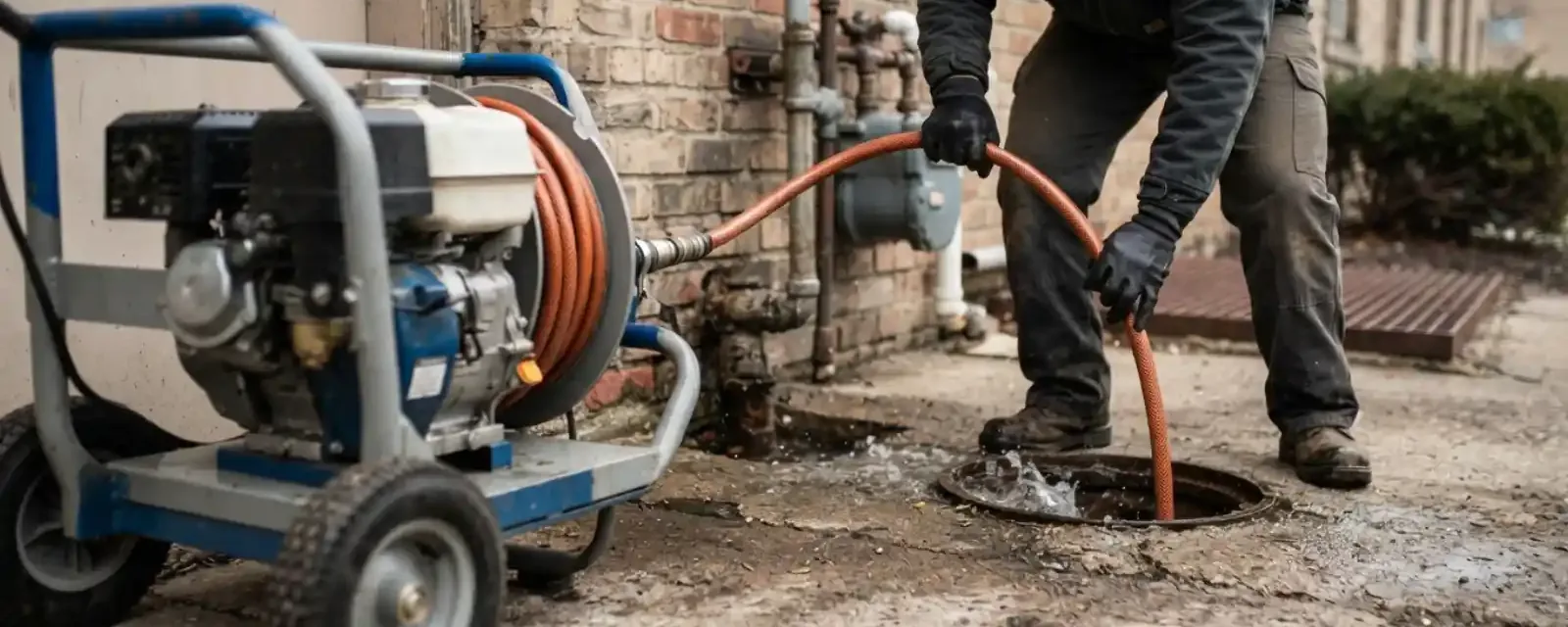
Emergency hydro jetting in Johnstown, CO
Hydro jetting sends water through a hose at high pressure to scour the inside of a pipe. It cuts through grease, scale and roots that a cable only pokes a hole through, and it leaves the pipe walls clean instead of just opened. If a main line is backing up into your home, call (970) 708-6013. The line is open 24/7, and the dispatcher will talk you through the next steps while a plumber heads out.
Jetting is most often chosen after a cable has failed or a clog has returned. It is also a smart move when a camera shows heavy buildup that will just refill the pipe.
Jetting compared with cabling
The two tools solve different problems. Here is how the choice usually plays out.
| Question. | Cable machine. | Hydro jet. |
|---|---|---|
| What it does. | Cuts or pulls a clog free. | Scours the whole pipe wall with water. |
| Best for. | A single hard blockage or a quick fix. | Grease, scale, roots and repeat clogs. |
| What it leaves behind. | A path through the debris. | A clean pipe, with the debris flushed out. |
| Pipe condition needed. | Works on most pipe. | Needs sound pipe, so a camera check comes first. |
| How long it lasts. | Often short if grease coats the walls. | Longer, since the coating is gone. |
Plenty of lines need only a cable, and that is covered under drain cleaning. A plumber picks the tool by what the line actually needs.
When a backed-up line is an emergency
A slow drain can wait. Wastewater rising in a tub, shower or floor drain cannot. While you wait for the plumber, do this.
- Stop using sinks, toilets, the dishwasher and the washing machine. Every drop goes into a line that cannot take it.
- Keep children and pets away from standing wastewater, and wash hands after any contact.
- Move rugs, boxes and electronics off the floor. Stay away from outlets near wet areas.
- Do not pour chemical cleaners into a backed-up line. They can splash and they make the next repair riskier.
- Find the cleanout if you can, usually a capped pipe outside or in the basement, and tell the dispatcher where it is.
Nights, weekends and holidays reach the same 24/7 line. Jetting at that hour depends on equipment access, so the dispatcher confirms what can happen first.
What happens on a jetting visit
Camera first.
A small camera goes down the line to find the blockage and check the pipe for cracks, sags or breaks.
Open a way in.
The plumber uses the cleanout, or pulls a fixture if there is none.
Jet the line.
A hose with a nozzle works down the pipe while water scours the walls and pushes debris along.
Pull back and rinse.
The nozzle works back out to carry loose debris to the main.
Verify.
A second camera pass or a running-water test shows the line is clear and draining.
Grease, scale and roots: three problems jetting solves
Grease cools inside a pipe and coats the walls a little more with each dishwasher cycle. A cable punches through the middle and leaves most of the coating behind, which is why the same sink backs up again in a few weeks. Jetting strips it off.
Scale is hard mineral buildup that narrows the pipe. Roots are the other common culprit, because they find the smallest crack and grow into thick mats. Jetting can cut roots back and clear the debris, but the camera tells you if the pipe is cracked. If it is, sewer line repair is the real fix.
When jetting is the wrong tool
Jetting is powerful, and a plumber will not use it where it can do harm.
- Pipe that is cracked, collapsed or separated at a joint, since pressure can worsen the damage.
- A pipe with a belly or sag that holds water, which needs repair and not just cleaning.
- Lines with a very thin wall or a patch that could be torn out.
- A blockage that is a foreign object such as a toy or a chunk of masonry, which needs retrieval.
That is why the camera comes first. If it shows a damaged line, the plumber explains the better option before anything is jetted.
Cable got stuck partway or the clog keeps coming back? Call the 24/7 line and describe how far the cable reached. That tells the plumber a lot.
Call (970) 708-6013Older lots, newer lots and restaurants
Around Parish Avenue, the original 1902 townsite has lots that are well over a century old, and an older line is more likely to have root intrusion or joint damage than a newer one. A camera check before jetting is worth it there. Newer neighborhoods like Thompson River Ranch and Pioneer Ridge are more likely to need grease and wipe clearing, so tell the plumber the age of your home.
Commercial kitchens share a grease problem wherever they are, including along I-25 and US-34 near the Johnson's Corner truck stop. Restaurant drain lines take fat every day, and regular jetting can cost less than repeated emergency calls. Tell the dispatcher if the property is a business.
What changes the price of hydro jetting
Jetting is priced by the job, so a quote needs a few details.
- Pipe length and size A long run of four-inch main takes more time than a short branch.
- What is in the pipe Heavy grease or roots take more passes than light buildup.
- Access A working cleanout speeds the job. Without one, a fixture may need to be pulled.
- Camera work A camera check adds time and shows what the pipe really needs.
- Time of the call A midnight backup is dispatched and priced differently from a visit booked for Tuesday.
Cleaning a clogged line is usually a maintenance cost, though a sewer backup endorsement can change that. Look at your policy for a sewer backup endorsement. Call (970) 708-6013 to get a number, and the price is clear before work starts.
Keeping a jetted line clean
A freshly jetted pipe stays clear much longer if the household keeps grease, wipes and paper towels out of it. Put cooking fat in the trash, and keep the toilet to toilet paper only.
If you are near Milliken or the surrounding towns, the same service is available there. For repeat backups, a periodic jetting plan beats a string of emergency calls.
Hydro jetting questions from Johnstown homeowners
Yes. The 24/7 line takes backup calls at any hour, including nights, weekends and holidays. Stop using water in the house and tell the dispatcher what is backing up. The plumber decides on site whether to cable first or jet.
A snake or cable pokes a path through a clog. A hydro jet scours the whole pipe wall with high-pressure water and flushes the debris out. Jetting is what stops repeat clogs from grease and scale.
On sound pipe, no. On cracked, collapsed or very worn pipe, it can make things worse. That is why a camera check comes first, and why the plumber may suggest another option if the pipe is damaged.
Often. A cable that stops at a spot can hit a root mass, a grease plug or a damaged joint. A camera finds out which, and jetting is useful for the first two.
Most homes never need it on a schedule. Restaurants and homes with repeat grease or root problems may benefit from yearly or twice-yearly jetting, depending on what the camera shows.
It cuts back roots inside the pipe and flushes them out. They grow back if the pipe still has a crack for them to enter, so the camera result decides whether a repair is needed.
Ownership usually changes hands where your pipe meets the sewer main. The exact spot varies by lot, so the Town of Johnstown public works office is the one to ask about your address.