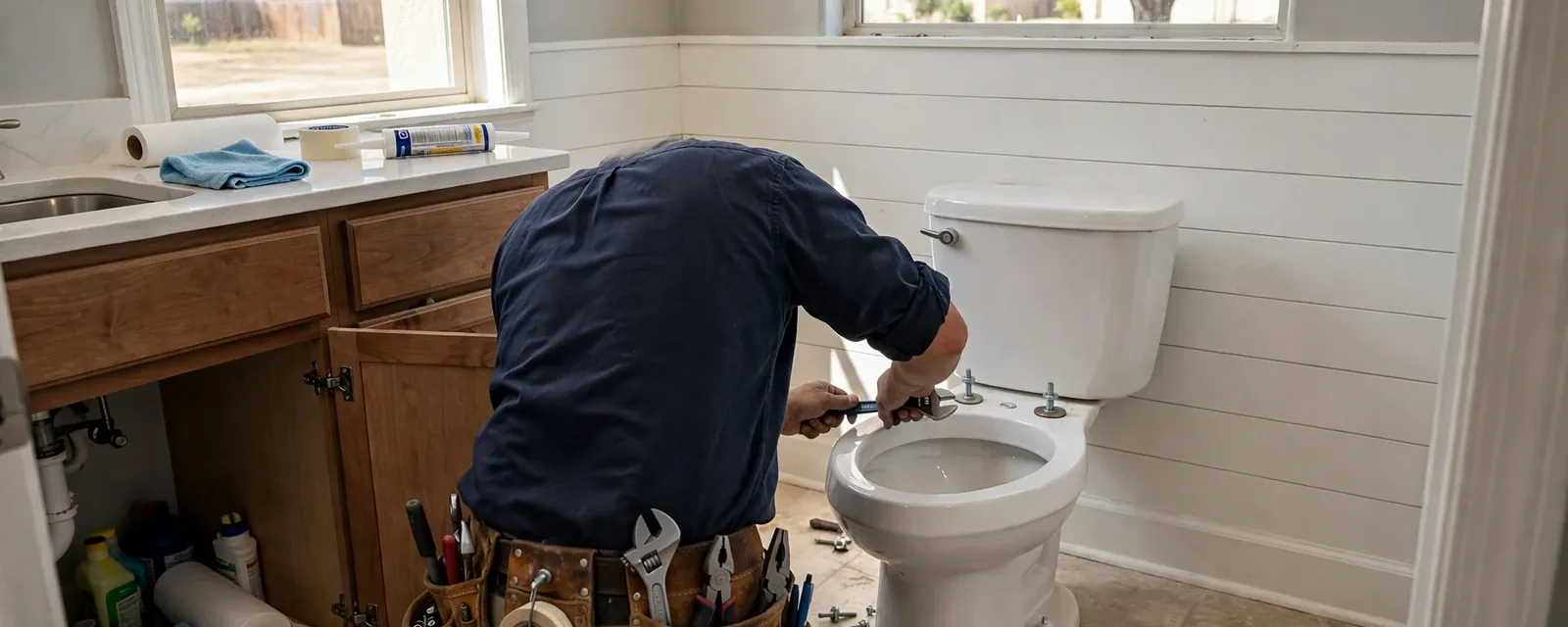
Start with the measurement that decides everything
Before you buy a toilet, measure from the wall behind the tank to the center of the bolts that hold the bowl to the floor. That number is the rough-in, and most homes use 12 inches. A 10-inch or 14-inch rough-in is less common, and a standard toilet will not fit those without leaving a gap or pushing the tank against the wall.
Also measure the space around the bowl. Check how far the toilet can stick out before it blocks a door or a vanity, and how much clearance sits to each side. Take the old toilet's model name or a photo to the store so the new one lines up with the supply valve and the floor bolts.
Gather these before you shut the water off
A toilet swap stalls when you have to leave a dismantled bathroom for a missing part. Put everything within reach first.
- The new toilet, with its tank, seat, tank bolts and bowl bolts.
- A new wax ring or a wax-free seal, plus a spare in case the first one gets squashed.
- A new braided supply line sized to the shutoff valve and the tank inlet.
- An adjustable wrench, a putty knife, a level and a bucket.
- Old towels, a sponge and a bag for the old toilet's wet parts.
Do not reuse the old supply line or the old wax ring. Both cost very little compared with the damage a failed seal can do to a subfloor.
How the install goes, one step at a time
This is the usual order for a standard floor-mounted toilet.
Shut off and drain.
Close the shutoff valve behind the toilet, flush, and hold the handle down until the tank is empty. Sponge out what remains.
Disconnect and lift.
Unscrew the supply line from the valve, remove the bolt caps and nuts at the base, then rock the bowl gently and lift it straight up. Set it on towels.
Scrape and inspect the flange.
Scrape the old wax off the flange with a putty knife. Look for cracks, a loose ring or a flange sitting below the finished floor.
Plug the drain.
Stuff a rag into the open pipe so sewer gas stays out and nothing drops in, then remove it before you set the bowl.
Set the new bowl.
Place the wax ring, lower the bowl straight down over the bolts, and press it down with your weight. Do not twist it once it touches the wax.
Tighten and level.
Tighten the base nuts a little at a time, alternating sides, and check level each round. Stop when the bowl does not rock. Overtightening cracks porcelain.
Mount the tank and reconnect.
Seat the tank on its gasket, tighten the tank bolts evenly, connect the supply line, and open the valve slowly.
Flush several times and run a dry paper towel around the base and the supply connection. Any damp spot means one of those joints needs another look.
The flange is where installs go wrong
The flange is the ring on the floor that the toilet bolts to. It should sit on top of the finished floor, not below it, or the wax ring cannot seal. If you installed new tile or vinyl since the last toilet went in, the flange may now sit too low.
A flange spacer ring or an extra-thick seal can fix a small gap. A cracked or rusted flange needs a repair ring or replacement, and a rotted subfloor under it needs attention before any toilet goes back down. That is the point where many homeowners stop and call.
A toilet that rocks after tightening, or one that smells of sewer gas, almost always has a flange or seal problem. Pulling it again and checking the ring costs less than the stained ceiling below a leaking bathroom.
What you find under the old toilet and what to do
Most surprises show up the moment the bowl comes off the floor. This is how they usually read.
| What you see. | What it usually means. | Next move. |
|---|---|---|
| Black or soft wood around the flange. | A slow leak from a failed seal over time. | Stop and have the subfloor checked. |
| Flange below the finished floor. | New flooring raised the surface. | Use a spacer ring or a taller seal. |
| Cracked plastic ring. | Age or past overtightening. | Replace the flange before setting the bowl. |
| Rust on the bolts and ring. | Moisture at the base for a long while. | Replace the hardware and inspect the ring. |
| Water or sewer smell at the drain. | The wax ring failed. | Reset with a new seal. |
Toilet leaking onto the floor right now? Close the valve behind the bowl and call the 24/7 line. A plumber can reset it or swap it out.
Call (970) 708-6013Johnstown water and your new supply line
The Town of Johnstown runs its own water treatment plant, so ask the Town's utility about your water if you want specifics. In November 2019, many residents saw yellow water, an event attributed to a raw-water source changeover. After any event like that, sediment can sit in supply lines and clog the small screen at the toilet's fill valve.
That gives you a practical step on any install in town. Before you connect the new supply line to the tank, point the line into a bucket and open the valve for a few seconds so loose grit runs out. If the toilet fills slowly later, check the fill valve screen first.
Permit rules for fixture swaps are not something to guess. Ask the Town of Johnstown building department whether your project needs a permit before you start, especially if you are moving the toilet or changing the drain.
Older Downtown homes and newer subdivisions
The original townsite around Parish Avenue was platted in 1902, so some Downtown Johnstown bathrooms have seen decades of repairs. Floors in older bathrooms can be uneven, and shutoff valves that have not turned in years may leak or seize. If the valve behind the toilet will not close all the way, stop and call, because forcing it can snap it.
Johnstown grew from 9,887 people in 2010 to 17,303 in 2020, and most of that growth is in newer subdivisions. Toilets in newer homes are usually easier to swap, but a builder-grade flange or a thin subfloor still deserves a look once the bowl is off.
If a toilet runs, leaks or will not flush in the middle of the night, the same 24/7 line covers it. A planned install is a daytime job, but a toilet failing overnight is a call for the toilet repair and installation team.
When to hand it to a plumber
Call a plumber when the flange is damaged, the floor is soft, the drain is not where the new toilet expects it, or the shutoff valve will not close. Those are fixes, not installs. They are also the problems that cause leaks later if they are covered up.
A plumber can also move a toilet, add a new bathroom or run supply and drain lines for a remodel. For that kind of work, look at plumbing installation rather than a simple fixture swap.
The same crews reach neighbors in Milliken and Mead, so a house a few miles from town gets the same attention. Say where you are when you call and what you can see under the bowl.
Toilet installation questions in Johnstown
A straightforward swap takes most people a few hours, including the trip to buy a wax ring and a supply line. Add time if the flange is damaged, the floor needs repair or the shutoff valve has to be replaced.
No. A wax ring is made to seal once. Once the toilet has been lifted, the wax is squashed and will not seal the same way, so use a new one every time.
Usually the floor is uneven or the flange sits too high or low. Shim the base with plastic shims, or fix the flange height. Tightening harder cracks the porcelain instead of solving it.
Rules for fixture swaps are set locally and can change, so ask the Town of Johnstown building department before you start. A plumber doing the work will know what applies to your address.
Start with the supply valve, which should be fully open, then the fill valve inlet screen. After water-quality events, sediment can collect in that screen. Cleaning it often restores normal filling.
Yes. Call (970) 708-6013 for a planned install or for a toilet that is leaking at the base. A leak at night reaches the same 24/7 line.