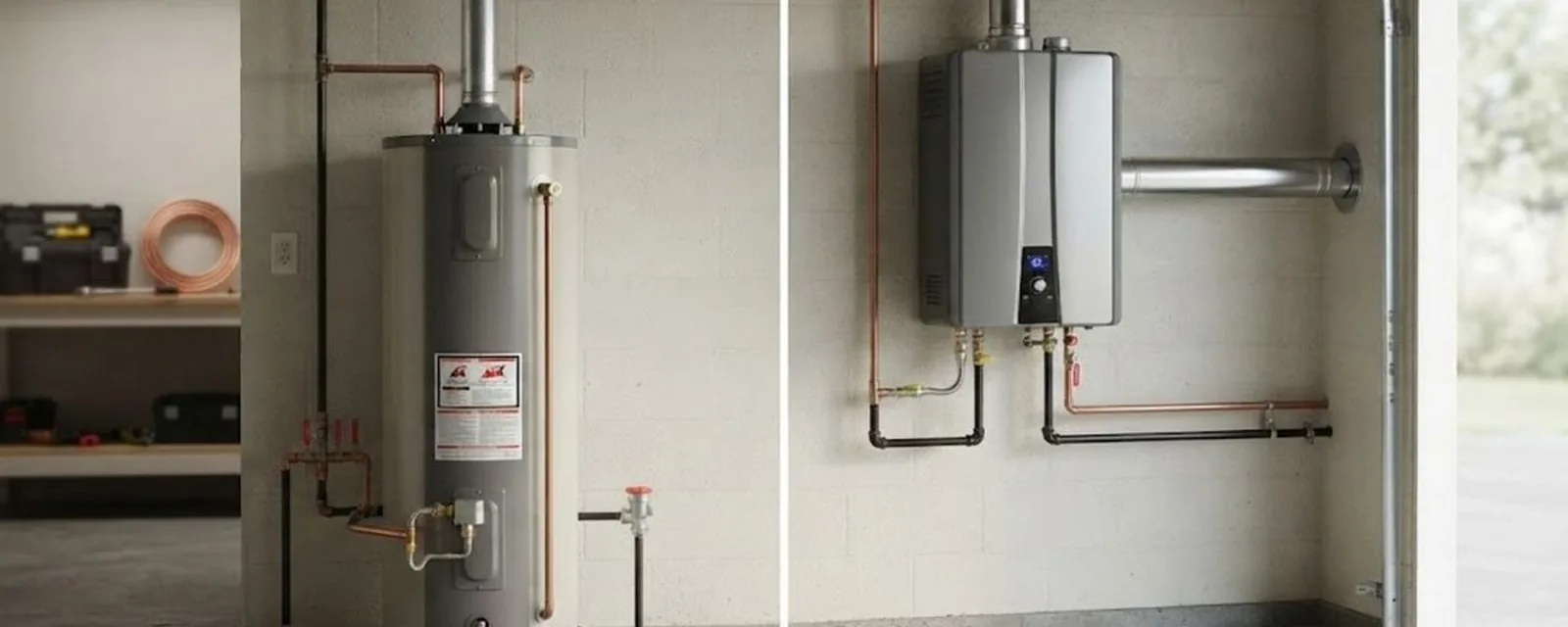
Tankless water heaters in Johnstown, CO
A tankless heater warms water only when a tap is open, so there is no tank to run out of and no storage to keep hot. That suits families with long showers and homes with tight space. It also asks more of the house, which is why the install and the upkeep matter.
This page covers new tankless installs, repairs and the flush that keeps them running. For tank-style heaters, see water heater installation. The 24/7 line also takes calls when a tankless unit fails in cold weather, and the dispatcher can sort out the urgency.
Tankless versus a tank heater
Both work well, but they suit different homes. This is how they compare in day-to-day use.
| Point. | Tankless. | Tank. |
|---|---|---|
| Hot water supply. | Steady while the demand stays within the unit's flow rating. | Limited by tank size, then recovers slowly. |
| Space. | Wall-mounted and compact. | Needs floor space. |
| Gas and venting. | Larger gas line and special venting. | Standard flue and a smaller line. |
| Maintenance. | Needs periodic descaling. | Needs an occasional tank flush. |
| If it fails. | Repair of a specific part, or replacement of the unit. | Leak means replacement. |
Flushing and descaling a tankless unit
Scale builds up on the heat exchanger and narrows the passages inside. Flow drops, temperature swings and error codes follow. A flush removes it before it does damage.
Shut off power and fuel.
Gas and power are turned off, and the water isolation valves are closed.
Connect the flush set.
A pump and hoses connect to the service ports on the isolation valves.
Circulate descaler.
A mild acid solution runs through the heat exchanger for the time the maker specifies.
Rinse and clean the filter.
Clean water goes through the unit, and the inlet filter screen is cleaned or replaced.
Restart and test.
Power and fuel come back on, and the plumber checks temperature, flow and the display.
Ask the plumber how often your unit should be flushed. The answer depends on your water and how much you use the heater.
Johnstown water and what builds up inside
The Town of Johnstown runs its own water treatment plant, but the plant tells you little about scale inside your heater. That depends on the minerals in the water that reaches your tap. A hardness test strip from a hardware store or a request to your water utility gives you the real number.
If your water is hard, flushes need to come more often, and a softener upstream may be worth a look. Johnstown has grown quickly, so if your unit came with a newer house and has never been flushed, the first one may be overdue.
Signs your tankless needs service
Most owners notice a change before the unit stops. These are the usual signals.
- Water turns lukewarm or swings between hot and cold during a shower.
- Flow at the tap seems weaker than it used to be.
- An error code shows on the display or the unit shuts itself off.
- The heater runs loudly, with rumbling or a popping sound.
- It has been a year or more since the last flush, or you do not remember the last one.
Write down the code and the brand before you call. Codes differ by maker, and the plumber can narrow the cause from the number.
Tankless unit down in the cold? Call the 24/7 line. If you smell gas, leave the building and call the gas utility or 911 before you call us.
Call (970) 708-6013Installing a tankless unit: gas, vent and power
The biggest surprise for most homes is the gas line. A tankless burner draws far more fuel than a tank burner, and a line sized for a tank often falls short. The plumber checks the pipe size and the meter before quoting.
Venting is the second piece. Tankless gas units use sealed, specific vent materials, and the run to outdoors has length limits in the maker's manual. At about 4,994 feet, Johnstown sits at an elevation where makers publish altitude adjustments for gas appliances, so the installer reads those for your model.
Electric tankless units skip the gas and vent but ask for heavy circuits. Your panel may need an upgrade, which adds to the job. The plumber tells you before you decide.
Repairs the plumber can make
Many tankless faults come down to sensors, igniters, flow switches, fans or a clogged inlet filter. Some have error codes that point straight at the part. A plumber with the maker's manual can read the code and confirm the fault with a meter.
When the heat exchanger itself is cracked or scaled past cleaning, the answer is replacement of that part or the unit. A tankless that is worn out is a good moment to compare it with a tank, and water heater replacement covers the full choice.
What changes the price of tankless work
Tankless jobs vary more than tank jobs, so quotes need a visit.
- Gas line and venting New or larger gas lines and new vent runs are often the biggest part of an install.
- Unit size Flow ratings differ, and a bigger home needs a bigger unit.
- Electric supply An electric unit may need a panel upgrade or a new circuit.
- Condition of the exchanger A flush is a service call. A failed exchanger is a major part.
- Water conditioning A softener or filter upstream may be suggested if scale is heavy.
Insurance seldom covers planned installs or scale damage, since both are wear-related. Your insurer can tell you where yours draws the line. For tankless pricing, call (970) 708-6013, and the price is clear before work starts.
Tankless water heater questions from Johnstown homeowners
The maker's manual sets the interval, and hard water shortens it. Many owners flush once a year. If you have never flushed yours or cannot remember when, schedule one.
Codes point to a sensor, igniter, flow, vent or scale problem, and the list changes by brand. Write the code down before calling. The plumber can read it, clear the cause and reset the unit.
Often not without changes. Tankless burners use more gas than tank burners, so the pipe size and meter need a check. The plumber measures the run and tells you what upgrade is needed.
Not always. If your water is hard, scale builds up faster, and a softener or more frequent descaling helps. Test your tap water or ask your water utility before deciding.
Yes, in most cases. Sensors, fans, igniters and filters are repairable. A heat exchanger that is cracked or fully scaled is the usual reason for replacement.
Yes. The 24/7 line takes tankless calls like no hot water in cold weather. If there is a gas smell, leave the building and call the gas utility or 911 first.
Usually yes, but the gas line, vent and wall space decide how big the job is. Start with a visit so the plumber can measure and explain the options before you commit.