Start with where and when the water shows up
Basement water has patterns. A damp patch after every rain is a different problem from a wet floor in spring. A musty smell with dry floors is different again. Write down where you see water, how often, and what the weather did before it showed up.
That note is the most useful thing you can hand a plumber. It points to the entry point, whether that is the wall, the joint between wall and floor, a window well or a plumbing line.
How water gets into a basement and what answers it
Most wet basements trace back to one of a few causes.
| Where it shows up. | Likely cause. | Typical answer. |
|---|---|---|
| Along the wall and floor joint. | Water pressure from the soil pushing through. | Interior drain channel and sump pit. |
| Mid-wall stains or white crust. | Moisture moving through the concrete. | Surface treatment, plus a look at grading and gutters. |
| Around a window well. | Poor drainage or a blocked well. | Clear or repair the well and extend downspouts. |
| A single spot on the floor. | A cracked slab or a plumbing leak. | Leak detection first, then a repair. |
| Water only during heavy storms. | Surface runoff and overloaded drainage. | Regrading, gutter fixes and a sump pump. |
If a spot stays wet when it has not rained, the water may be coming from a pipe, not the soil. Leak detection checks for that before any drainage work.
Check the outside before you pay for an inside fix
Some basement water starts on the surface. These checks cost little and are worth doing first.
- Clean gutters and make sure downspouts empty several feet from the foundation.
- Look at the soil next to the house. It should slope away, not hold water against the wall.
- Clear window wells of leaves and debris, and check that they drain.
- Look for wet spots near the water heater, the washer and the lowest drain.
- Check that sprinklers and drip lines do not spray the foundation.
- Note whether any crack in the wall or floor is growing or leaking.
Big, widening or stair-step cracks in a foundation wall can be structural. That is a job for a structural or foundation specialist, not a plumber.
Basement flooding right now? Call the 24/7 line. Water reaching the floor is an emergency, and a plumber can help stop the water and protect the space.
Call (970) 708-6013How an interior drainage system works
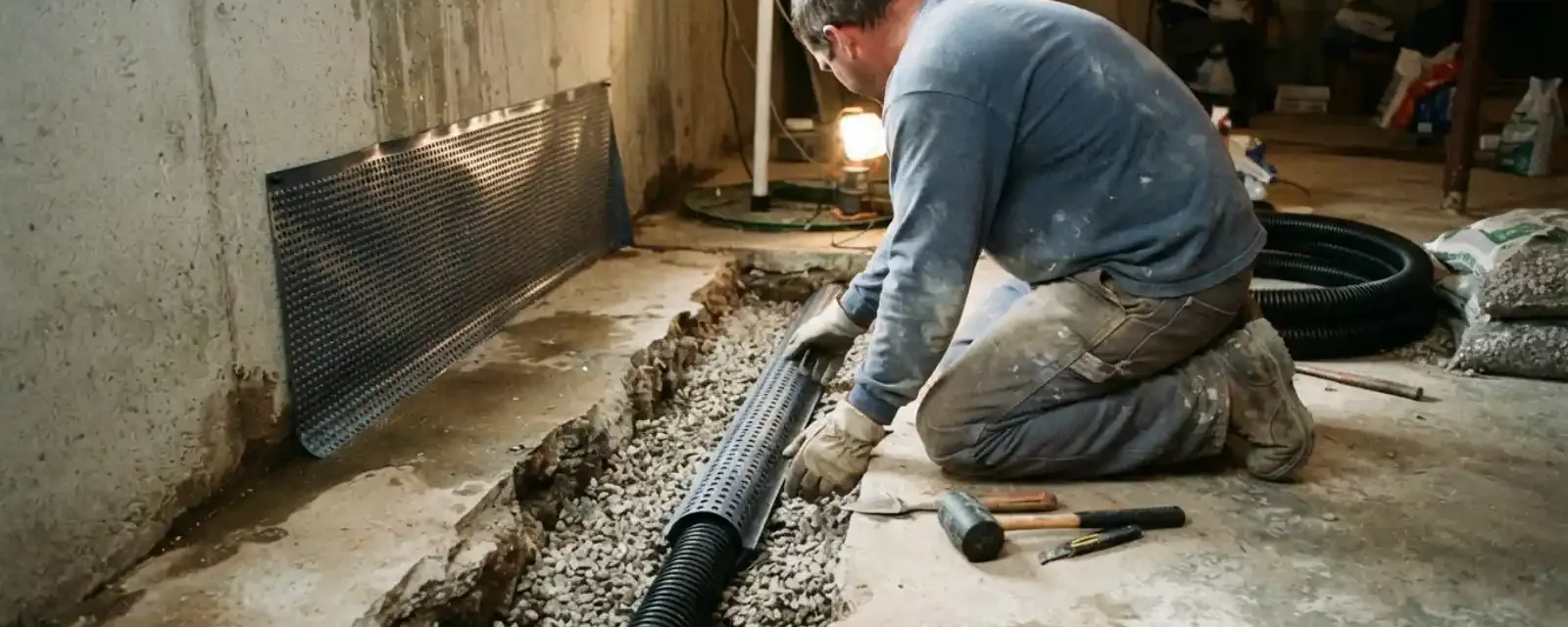
Interior systems catch water at the base of the wall and send it out through a pump.
Open the floor edge.
A strip of concrete along the wall is cut and removed so a drain channel can be set below the slab.
Lay the drain.
A perforated pipe goes into a gravel bed and slopes toward a sump pit.
Set the pit and pump.
A pit is placed at the low point, and a pump with a float is installed to send water outside.
Close and finish.
The concrete is patched over the channel, and wall membranes or covers are added where needed.
Test the system.
Water is run along the channel to confirm it reaches the pit and the pump clears it.
For pump details, see sump pump installation and repair. Outdoor discharge lines mean digging, and Colorado 811 is free and must be called at least 2 full business days before any dig.
What the land around Johnstown means for basements
Johnstown sits west of where the Big Thompson and Little Thompson rivers meet, at 4,994 feet. Land near rivers and irrigation ditches can hold more groundwater than higher, drier ground. A basement close to either may deal with water more often than one farther away.
The takeaway is to ask where your water is coming from, not just how to stop it. A plumber can look at the lowest point, the drain history of the house and the nearby grading. For rules on discharge or exterior work at your address, ask the Town of Johnstown building department.
French drains, window wells and what a plumber does and does not do
Exterior French drains are a gravel-and-pipe trench that moves water away from a wall. They are mostly an excavation job, and some are done by excavation or drainage contractors. A plumber focuses on interior drains, pits, pumps and any plumbing leaks that add to the water.
A good visit sorts those out and tells you if you need another trade. If the house has a finished basement, it also makes sense to talk about this before adding a bathroom. See plumbing installation for that planning.
What changes the cost of basement waterproofing
Waterproofing is project-based, so real numbers come from a plumber on site.
- How much wall is affected One corner is a small job. Water along several walls means a longer drain run.
- The floor and finish Bare concrete is easy to open. Finished flooring, framing or a built-out room adds demolition and repair.
- Pump and pit needs A single pit with a basic pump differs from a dual-pump setup with a battery backup.
- Where the water goes A discharge point that drains well is simpler than one needing a long run.
- Other causes found A plumbing leak or poor grading might need to be fixed first.
Most homeowners policies do not cover seepage or groundwater that comes up through the floor, but they may cover sudden water damage from a burst pipe. Read your own policy to see what yours says. Call (970) 708-6013 and describe the problem for a clear price before work starts.
When a damp basement turns into an emergency
Dampness can wait for a scheduled visit. Standing water, a failed pump, or water near the electrical panel cannot. Johnstown 24/7 Plumbing is open 24/7 for flooding, burst pipes and sump pump failures.
If you are dealing with a pump that stopped, go straight to emergency sump pump repair and call the line.
Basement waterproofing questions before you book
A plumber handles interior drainage, sump pits and pumps, and any plumbing leaks. Exterior excavation, grading and foundation repairs may need other trades. A plumber on site can tell which part of the problem is theirs.
Heavy rain raises the water in the soil and can overwhelm gutters and grading. Water then finds a crack or the joint between wall and floor. Fixing gutters, downspouts and grading helps, and a pump and drain may be needed too.
Watch when it appears. Water that shows up after rain points to the ground. Water that shows up with no rain, or near a pipe, may be a leak. Leak detection can confirm which one it is.
Usually yes. The drain channel collects water, and the pump sends it out. Without a place for the water to go, the system fills up. The plumber sizes the pit and pump to the setup.
No system removes every trace of moisture, and results depend on the cause. A plumber can explain what a drain and pump will and will not do for your basement before you commit.
Stay out of standing water near outlets, move belongings up, and call (970) 708-6013. The line is answered 24/7. If the water is near the panel, stay away and say so on the call.
Yes. Closing in walls over a wet area traps moisture. Settle the water first, then plan the framing, flooring and any bathroom.