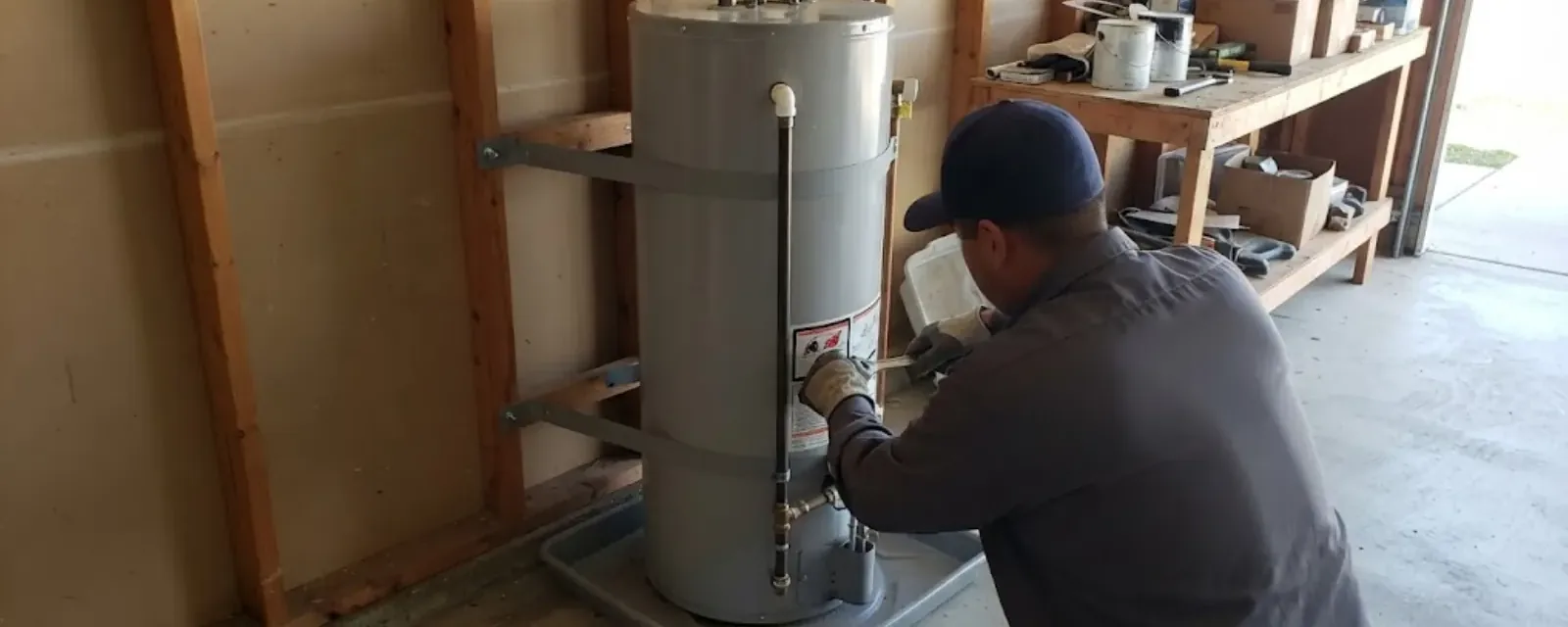
What a traditional install actually covers
A traditional water heater is the storage tank type, with a burner or electric elements heating a tank of water that sits ready. Installing one means more than setting a tank in the old spot. It includes the water connections, the fuel or power, the venting for gas units, and the safety parts around the tank.
A good installer treats each of those as its own step and checks it before moving on. If any one is skipped or rushed, the problem usually shows up later as a leak, a scorching drip, or a heater that cycles badly.
The install, from old tank to first hot tap
Here is the usual order for replacing a tank with a new tank of the same type.
Shut off and drain.
The plumber closes the cold supply, shuts off gas or power, and drains the old tank to a floor drain or outdoors.
Disconnect and remove.
Water lines, the gas line or electrical connection, the vent and the relief valve discharge pipe all come off before the tank moves.
Prepare the spot.
The floor is cleaned, a drain pan goes under the tank where needed, and the unit is set level on a firm base.
Connect water.
New flexible connectors or pipe tie in the hot and cold lines, with shutoff valves in reach and an expansion tank where the system calls for it.
Connect fuel and vent.
A gas unit gets a gas line with a shutoff and a sediment trap, plus a vent connection checked for draft. An electric unit gets its own circuit checked for size.
Fit the safety parts.
The temperature and pressure relief valve gets a discharge pipe that ends where it can run safely.
Fill, purge and test.
The tank is filled with a hot tap open to push out air, then power or gas goes on and the system is tested for leaks and proper operation.
Gas safety first
If you smell gas, do not look for the source and do not flip a switch. Leave the building first, then call the gas utility or 911 from outside. Gas-fired water heaters are safe when installed and vented properly, which is exactly why this is a job for a licensed plumber.
After an install, ask the plumber to show you where the gas shutoff is and how the vent connects. Know both before you need them.
Tank type and what it means for the install
The fuel type changes what has to be connected and how much of the house is involved.
| Choice. | What it needs. | Install detail. |
|---|---|---|
| Natural gas tank. | Gas line, vent, combustion air. | Venting and draft are checked carefully. |
| Electric tank. | Dedicated circuit and breaker. | No vent, but wiring size matters. |
| Larger tank. | More floor space and sometimes a bigger vent. | Check the closet or nook before buying. |
| Taller or wider unit. | Clearance to ceiling, walls and service access. | Measure the space, not just the old tank. |
If you are weighing a different unit, the tankless water heater page covers that type separately.
No hot water tonight? Call the 24/7 line. A failed or leaking tank can be replaced without waiting for the next business day.
Call (970) 708-6013Local water and what it does to a new tank
The Town of Johnstown runs its own water treatment plant. Water quality varies by area and by season, so the best way to know what your tank will face is to test your tap or ask your water utility for its quality report. Do not assume your neighbor's water matches yours.
Why does that matter for an install? Minerals and sediment settle at the bottom of any tank, and a flush once a year keeps the burner or lower element working freely. In November 2019, Johnstown water ran yellow for a time, an event attributed to a raw-water source changeover. Sediment in a tank after an event like that is a reason to flush it sooner.
Johnstown also grew quickly, from 9,887 people in 2010 to 17,303 in 2020. Many newer homes have the water heater in a garage or utility closet with limited clearance. Measure the space before you pick a tank.
Sizing the new tank
Match the new tank to how your household uses hot water. Count the people, the showers taken back to back, and whether a large soaking tub or a laundry room fills at the same time. A tank that is too small runs out mid-shower, and one that is too big wastes energy keeping extra water hot.
Replacing a tank with the same size is usually the simplest path. If your family has grown or shrunk, say so on the call. A plumber can recommend a size and check that the space, vent and fuel supply can handle it.
For an unplanned swap after a failure, the water heater replacement service handles emergency tank changes. A planned upgrade is covered by water heater installation.
Permit and inspection questions
Water heater installs often involve permit or inspection rules, which differ by town and can change. Do not rely on a store clerk or a neighbor. Ask the Town of Johnstown building department what applies to your address before the work starts.
A licensed plumber can pull any required permit and arrange the inspection. You can check that a plumber is licensed through the state's lookup at Colorado DORA license lookup, which lists Residential, Journeyworker and Master license types.
Nearby towns and what to expect on the day
The same crews serve Milliken to the east and Mead to the south, so a home outside Johnstown town limits gets the same install. Tell the dispatcher your address and tank type.
Plan on the water being off for part of the day, and clear a path to the heater. Move boxes, cars or storage so the plumber can bring the new tank in and carry the old one out.
When the job is done, ask for a walk-through. Look at the relief valve discharge pipe, the shutoffs and the pan, and find out when the tank should be flushed next.
Water heater installation questions
A like-for-like swap is usually a half-day job once the plumber is on site. Venting changes, a new gas line, a relocated tank or an expansion tank can add time. Say what you have when you call.
The plumber should inspect it. A corroded or poorly sloped vent can let exhaust spill into the house. If the vent shows damage, it should be repaired as part of the job.
The valve opens if pressure or temperature gets too high, and the discharge pipe carries that hot water to a safe spot. Without it, scalding water can spray into the room.
Leave the building at once, without switching anything on or off, and call the gas utility or 911 from outside. Do not try to find the leak. Call the plumber once the utility says it is safe.
Not that we can say without a test of your tap. Ask your water utility for its quality report or test the tap yourself. A plumber can then recommend maintenance such as flushing or an anode rod check.
Yes, for failures. Call (970) 708-6013 at any hour for a tank that leaks or has gone cold. The line is open 24/7.